

Fitness Equipment Sea Freight Export to Sydney, Australia
Business Background
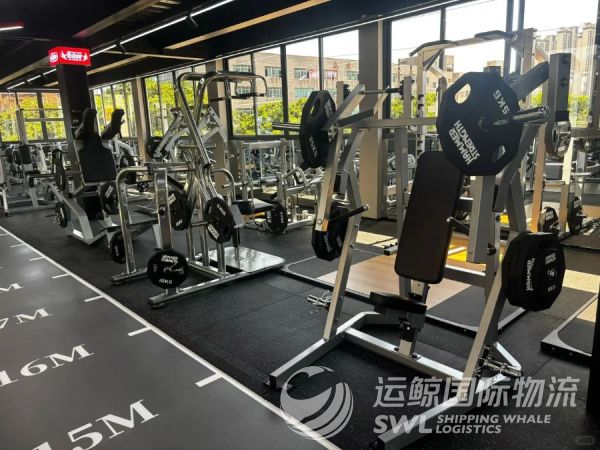
Our client Mr. Chen planned to invest in and open a gym in Sydney, Australia. He purchased a batch of fitness equipment from Tianjin, including treadmills, elliptical machines, stair climbers, and Smith machines, totaling 16.4 cbm. Because each piece is heavy, after disassembly and packing, it requires a 20GP full container load and is planned for shipment to Sydney for use.
Since he was unfamiliar with customs declaration and clearance procedures and Australia's import compliance rules, he entrusted our company to provide warehousing, professional packing, ocean freight, customs declaration and clearance, and other services. After the goods arrive at Sydney Port, our company will arrange local dedicated truck delivery to the client's store.
Business Process
Pre-export compliance and qualification preparation → equipment packing → self-delivery to warehouse → reinforced packaging + warehousing → booking space 2 weeks in advance → China export customs declaration → international ocean freight → customs clearance and tax payment after arrival → Australian market compliance retention → dedicated door delivery.
Key Precautions for the Full Process
I. Australian Customs Declaration, Clearance, and Compliance Requirements
1. Tariff and Tax Rules
- HS code classification: Most fitness equipment falls under heading 9506 (articles and equipment for general physical exercise, gymnastics, and athletics). Subcategories such as treadmills, dumbbells, and spin bikes correspond to different subheadings.
- Tariff policy: Under the China-Australia Free Trade Agreement, Chinese-made fitness equipment that meets rules of origin can enjoy preferential tariffs. Most basic fitness categories can be duty-free. The specific rate depends on the final HS code; the base rate for some categories is about 5%.
- Declaration threshold: If the value exceeds AUD 1,000, submit a formal import declaration electronically through the Australian Customs ICS system.
2. Required Customs Clearance Documents
- Basic documents: commercial invoice (with detailed product names, materials, value, and quantity), full set of ocean bills of lading, and detailed packing list.
- Proof of origin: certificate of origin / origin declaration, completed in English and in the format filed with customs.
- Packing and quarantine documents: When using wooden packaging / wooden pallets, provide an IPPC fumigation/heat treatment certificate, and the wood must be bark-free. For full container shipments, submit a container cleanliness declaration to prove there is no soil, plant or animal residue, pests, or other biosecurity risk material inside the container.
3. Product Market Access Compliance
- Electrical safety certification: Powered fitness equipment with motors and electronic displays (treadmills, elliptical machines, spin bikes, etc.) must obtain Australian RCM certification. Otherwise, you cannot legally sell or distribute it in Australia, and Australian customs may detain it after arrival.
II. Packing Precautions
1. Product Protective Packaging
- First wrap fragile and damage-prone parts (electronic consoles, handles, plastic housings, etc.) separately with bubble wrap and EPE foam, then fix them in cartons with custom foam inserts. Fill gaps to prevent movement during transport.
- For heavy and irregular equipment (gantry frames, barbell racks, etc.), use fumigation-free wooden crates. Add internal supports for reinforcement and corner impact protection. If a single piece is too heavy, leave space for forklift handling.
2. Marking and Document Matching
- Label the outer carton with carton number, gross weight, dimensions, consignee information, and handling marks such as "Fragile" and "This Side Up".
- The packing list must correspond one-to-one with carton numbers and detail the product name, quantity, and material in each carton for Australian customs inspection and verification.
III. Shipping Precautions
1. Shipping Plan and Billing
Fitness equipment is often heavy cargo or volumetric cargo. For larger volumes, use FCL (20GP/40HQ); for smaller volumes, choose LCL. Sydney Port is a base port in Australia with stable routes; for LCL, watch out for mixed-cargo risks.
2. Risk Prevention During Ocean Transport
When loading the container, balance the weight. Place heavy equipment lower and secure it with straps and wooden blocks to prevent shifting, tipping, or collision damage when the vessel pitches and rolls.